From a Viral Render to Reality
A year and a half of prototypes, moulds, failed processes, and one hidden metal frame. This is how SolesFantasy finally became real.
After one image went viral, I really did turn it into a product.
Many people may have seen the render of My Darling. In the summer of 2024, I posted it almost casually to Qzone and X. Within days it had travelled through QQ groups, Tieba, Weibo, Xiaohongshu, and Douyin.
(Qzone, QQ groups, Tieba, Weibo, Xiaohongshu, and Douyin are Chinese social-media platforms.)
People reposted it as a meme. Then they came to ask:
“Is it a real product?”
“Where can I buy it?”
That was when I understood that this small idea from my head might actually need to exist.
Nearly a year and a half passed between that image being seen and SolesFantasy becoming a complete product. Consider this a late development diary—and an answer to everyone who waited.
The idea before the image
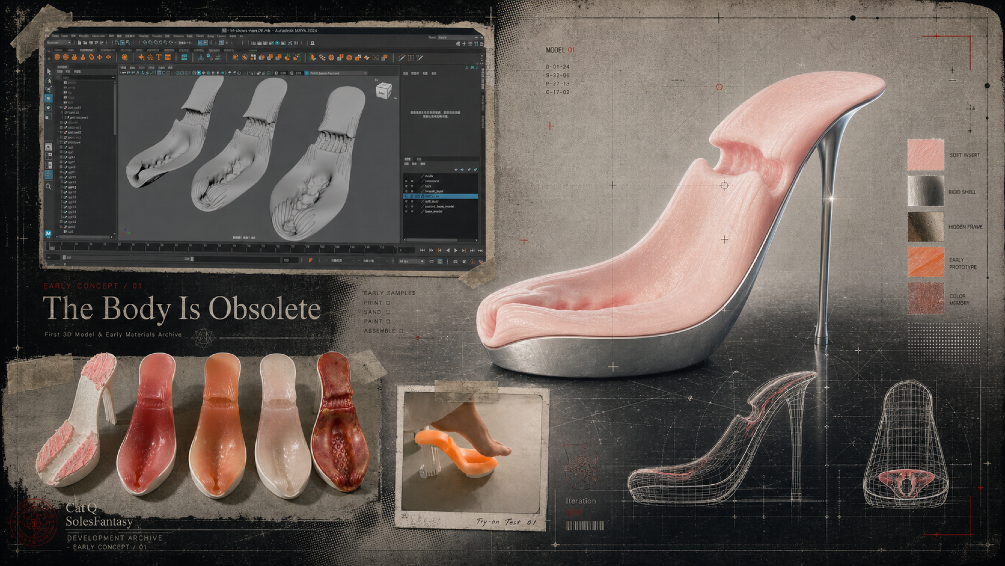
The thought of a high heel with a channel running through it first appeared about five years ago. It was one of many ideas I played with while stealing a little time from ordinary work.
Most designers do this: test the strange objects in their heads and see whether fantasy can be given weight, surface, and form.
Seen in public for the first time
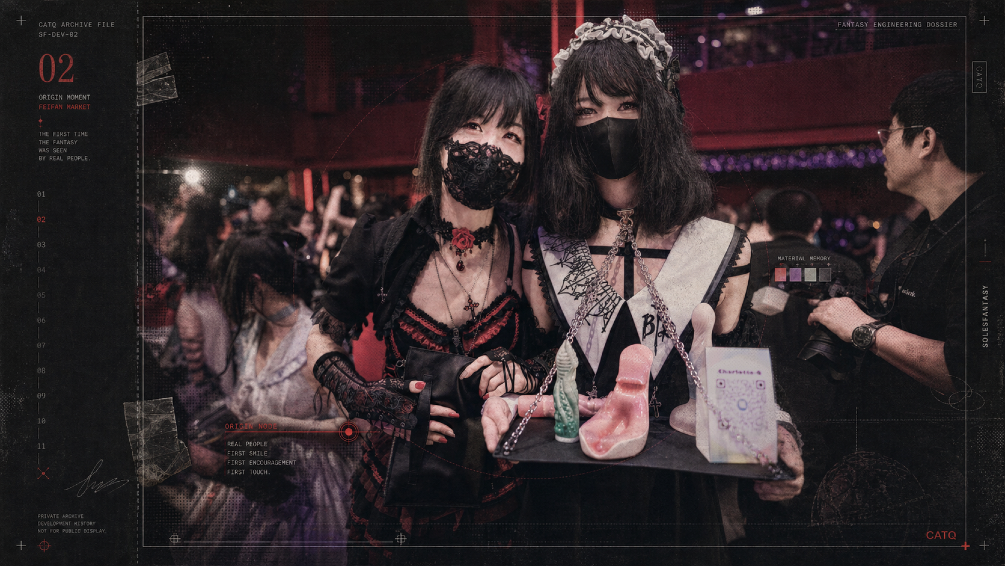
The real beginning came in the summer of 2024, when Huahua brought me to Feifan Market. It was my first experience of a gathering that was both a community event and a creators’ market. I brought a few small things I had made—and took my little dog, @cjdsnowy, along for the day.
(Feifan Market is a hobby and subculture market, including BDSM and other niche communities.)
Nothing was for sale yet. Still, people stopped. They looked closely, talked, and asked serious questions about an idea I had assumed was simply too strange. That attention gave me the courage to continue.
Later that summer, at home with the air-conditioning on and a slice of watermelon beside me, I opened Maya and rebuilt the idea. I added straps, made the soft form fuller, and redesigned the channel details beneath the forefoot and arch.
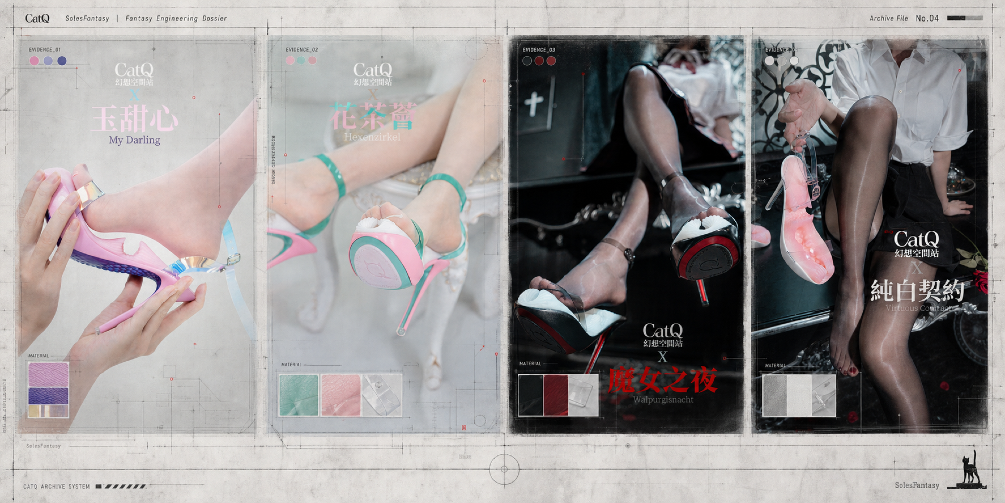
I rendered four colourways and posted them to Qzone. Then the image escaped my account and began travelling on its own.
700 orders in 15 days
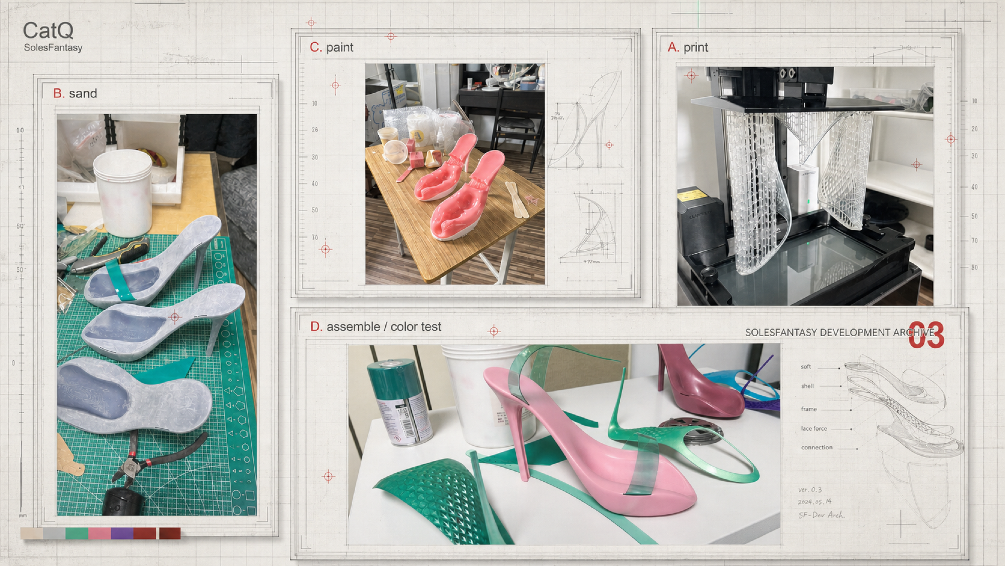
Over the next month, I revised the model, made samples by hand, printed prototypes and resin moulds, sanded, painted, assembled, and finally completed samples in all four colourways.
There was finally something real to photograph. I planned a 30-day pre-order for what I still imagined would be a small run of custom-made pieces.
The pre-order reached 700 in 15.
I had honestly believed I could make them slowly at home. Reality arrived quickly: by hand, I could finish only a dozen or so pairs in a month. The order volume was impossible.
I stopped the pre-order and went south to find a factory.
(Here, “went south” means travelling to the manufacturing regions of coastal southern China to work directly with factories.)
Making one was not the same as making many
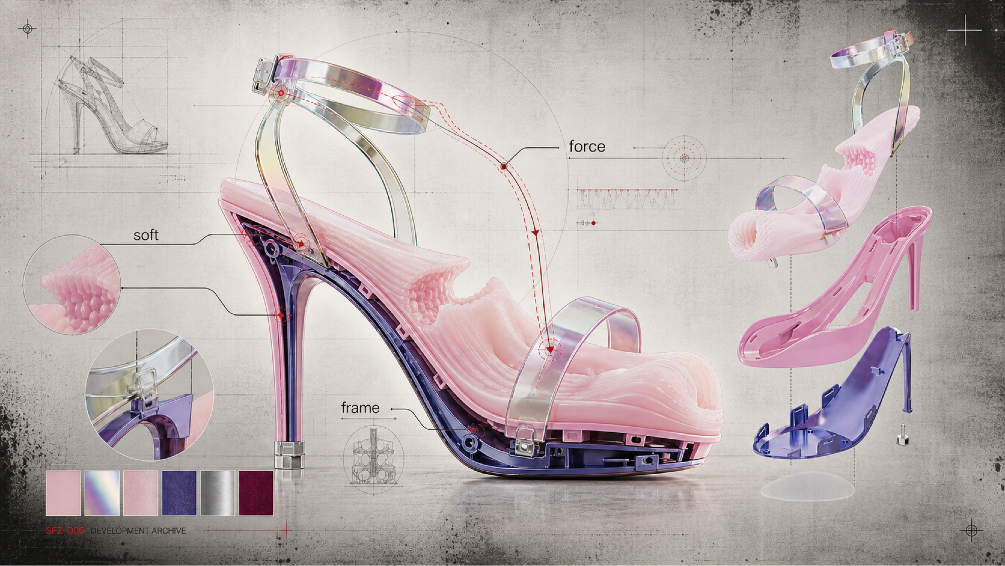
SolesFantasy had to work as a wearable high-heel fantasy object while holding a very soft, platinum-cured silicone insole. Two problems defined almost everything that followed.
Joining soft and hard
Silicone is difficult to bond reliably to other materials. Across a large contact area, adhesive introduced overflow, deformation, unstable edges, and a poor production yield.
Anchoring the straps
Traditional shoes can wrap straps beneath the insole and secure them with tacks and adhesive. A very soft silicone insole cannot be fixed that way, and I did not want strong shoe adhesive inside an object designed for close bodily contact.
Three routes, two failures
I travelled along the manufacturing belt of China’s southeast coast, visiting adult-product OEMs, mould makers, and shoe factories. Three possible routes kept returning.
(OEM means “original equipment manufacturer”: a factory that manufactures products for other brands.)
Adhesive bonding
Direct, but difficult to control at the edges and unreliable at production scale.
Two-shot moulding
Visually elegant and close to a seamless form, but unable to achieve the softness the design required.
Overmoulded structure
The most complex and expensive route—and eventually the only one that worked.
I chose two-shot moulding first. It was clean, integrated, and repeatedly presented as achievable. At the end of 2024, the factory told me it could not be done: the injection-grade material would not reach the intended softness.
We fell back to adhesive. Several rounds of testing still could not solve stability or yield. The factory returned the deposit and stopped the project.
That was the first major lesson. I had thought I could hand an idea to a manufacturer and step away. I could not.
Choosing the hardest route
At the beginning of 2025, I changed manufacturing partners. That was when the product truly entered development.
I spent almost the entire year in Dongguan—moving between factories and suppliers, studying moulds, materials, tolerances, structure, and yield, then revising the design again.
(Dongguan is a major manufacturing city in Guangdong, within southern China’s Pearl River Delta.)
When adhesive and two-shot moulding had both failed, only the third route remained: a concealed metal support structure encapsulated inside the silicone insole.
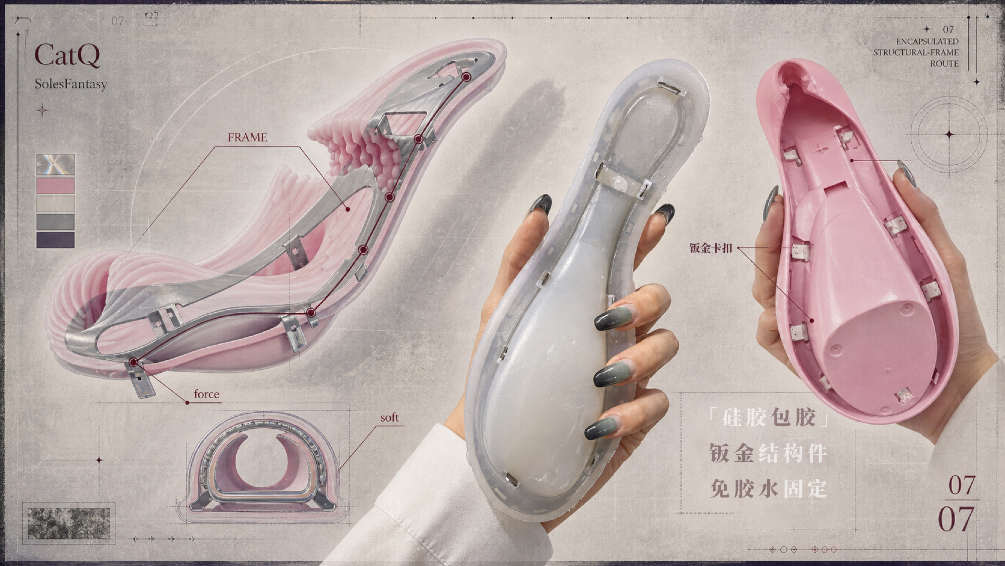
This was the step that turned SolesFantasy from a render into a product. It also meant more parts, more moulds, higher cost, and far more opportunities for error. Overmoulding a complex steel structure of this kind had little precedent among the factories we approached, so almost every stage had to be discovered through trial.
By May 2025, the moulds were ready. Then precision became the next enemy.
The galvanized steel sheet support is double-curved and springs back after stamping. During overmoulding, it must stay perfectly fixed while silicone fills the mould. If its position shifts, the thinnest areas may fail to cover the metal, or the silicone thickness becomes uneven. In production, a fraction of a millimetre can decide whether a piece is usable.
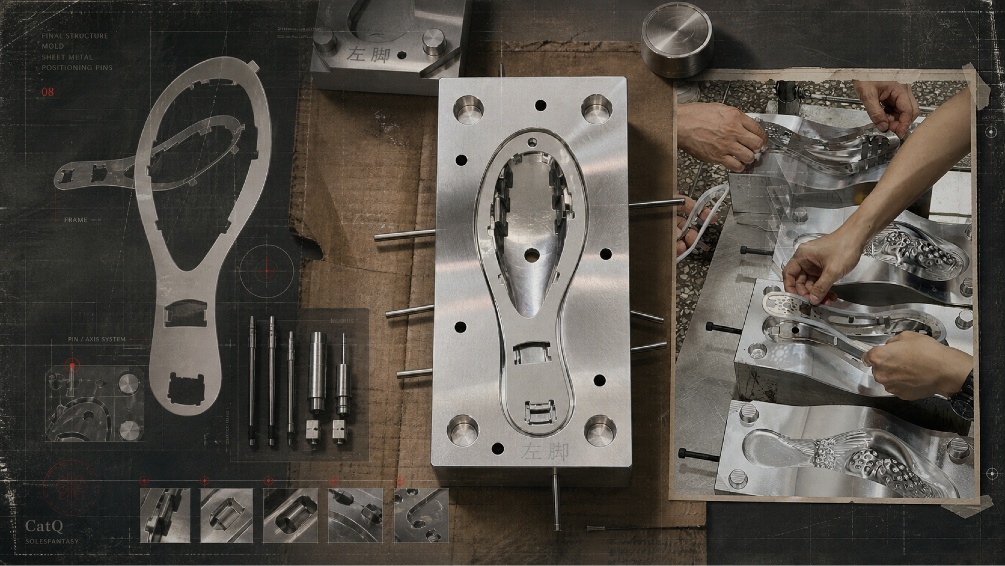
The tooling was revised several times and still had to be remade. We changed sheet-metal suppliers twice, rebuilt the silicone mould, and designed a dedicated pin system that could hold the structure securely while remaining fast enough for hand-poured production.
All summer, every test seemed to be only a little away from working. In manufacturing, that little distance is often the most difficult part.
Why three sizes took so long
The structure and moulds were finally approved in September. Production samples reached the Guangzhou International Sex Expo at the end of October. After the show, we prepared stock and continued improving yield. Size M went on sale at the end of November.
(The Guangzhou International Sex Expo is an adult-industry exhibition held in Guangzhou, China.)
Friends in manufacturing and e-commerce kept asking why I did not make only one size. If it could sell, why spend more than twice the investment on S, M, and L?
Because that was what I had promised in the pre-order. Without everyone’s enthusiasm, I would never have continued. Once I had made the promise, I had to keep it.
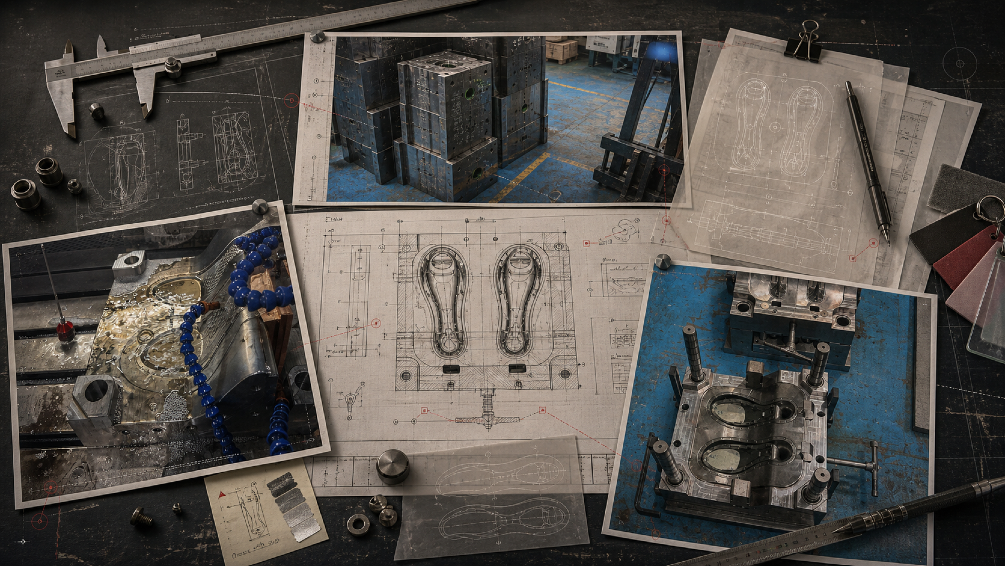
A shoe size is not a simple scaled copy. The soft insole, high-heel body, two channel forms, and double-curved metal support all have to be adapted as one system.
Structure and mould system approved.
Size M entered sale after the expo and production tuning.
S and L tooling, trials, sample revisions, and material preparation continued after factories reopened.(“Factories reopened” refers to the post–Lunar New Year restart, when many Chinese manufacturers pause for the holiday and resume production gradually.)
Materials arrived for S and L production. A final issue with the painted heel bodies required one more return to the supplier.
Only after that last correction could I finally say it: SolesFantasy, in all three sizes, was real.
What an original product asks of us
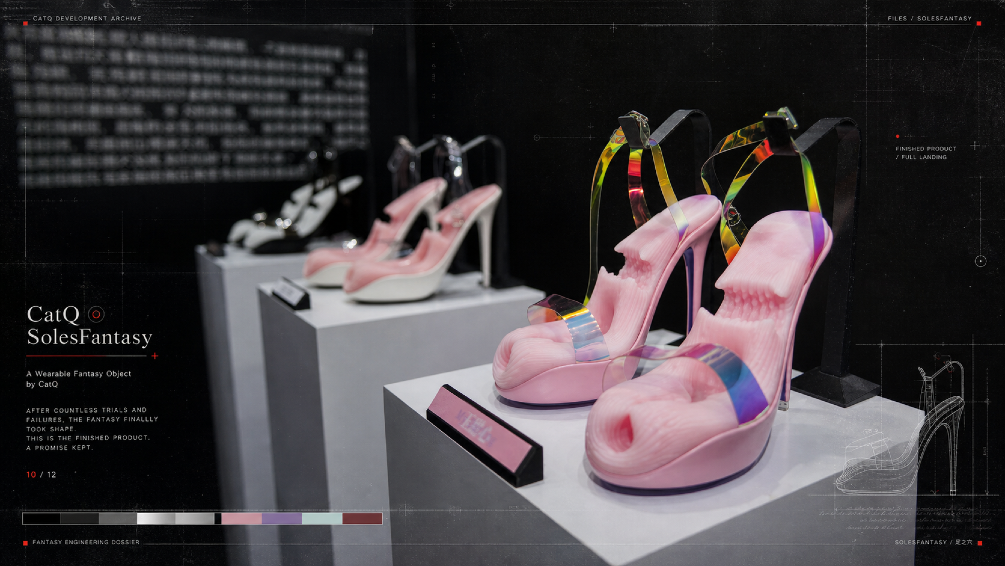
People told me that making something original was pointless. That I should work with the copyists. That I should sell first and solve the details later.
I still believe a good product is the foundation CatQ needs in order to continue. I did not want to make only beautiful renders, or depend on a strange concept to create an impulsive order. I wanted the thing CatQ delivered to deserve the fantasy people felt the first time they saw it.
Perhaps that is also my excuse for being bad at marketing.
Much of CatQ has travelled through people sharing it simply because they cared. I am deeply grateful—and I also owe everyone an apology.
Because development took so long, imitation products appeared before ours was ready. For many people, the first physical version they saw was a poor copy. I do not even like calling them counterfeits. They are approximations made without understanding the structure or what CatQ intended to express.
They cannot represent this design, its construction, or the experience we wanted to give.
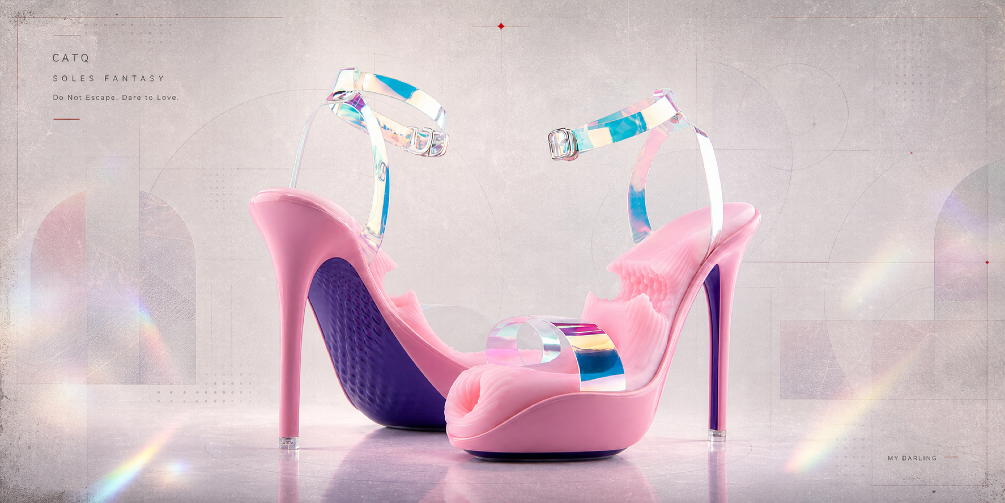
I only hope the SolesFantasy that finally reaches people has not betrayed the long wait.
While everyone waited, we were also learning how to make CatQ’s world more precise and more meaningful. More objects, more dreams, and many new fantasies are already in development.
Thank you to everyone who stayed until now.
Thank you to everyone who urged me on, complained that I was slow, and still did not leave.
Thank you to everyone who saw a render and waited for it as if it were already a real work.